By Robin Noble (Photos by Martine Howard)
Our “Côte Rocheuse” has long stretches of high cliff, broken by deep bays, where many of the attractive coastal towns like Port Vendres and Collioure are situated. There are much smaller bays as well, some under the high expanses of rock, others within the larger inlets. Particularly if it is breezy, we spend a lot of time swimming around in these little, often idyllic places, and as they are fairly shallow, have come to notice the often subtle differences in the seabed.
Recently we were in exactly such a place; it is not at all deep, and provided with one or two large rocks, so few boats actually anchor there, and the seabed is relatively unscathed. Some of it is almost sandy, there are areas of small stones, and where the coastal rocks slide down into the sea, there are narrow cracks and small chasms, relatively deep and dark. Most of it is quite well “vegetated”, with large areas of low, gungy algae, and several of the white, whorled, flower-like things, which are called “peacock’s tail”. (I say “things” because I am not totally sure whether they count as plants or not!)
It was very sheltered and calm, and I was able simply to relax, enjoy my swimming, and have a good look at what was going on under the surface of the gently moving sea. There were quite a few little fish scooting around, often babies of the friendly saddled bream, which like to hang around under the hull of our boat. But, out of the corner of my eye, I saw a few, different fish, nosing between the stones; they were wrasse (I think of at least two kinds, certainly there were rainbow wrasse of both sexes), and they seemed to be concentrating on something, almost, one would say, harassing it. For a moment, I thought little of it, but then the “something” moved, and so I swam over to have a better look.
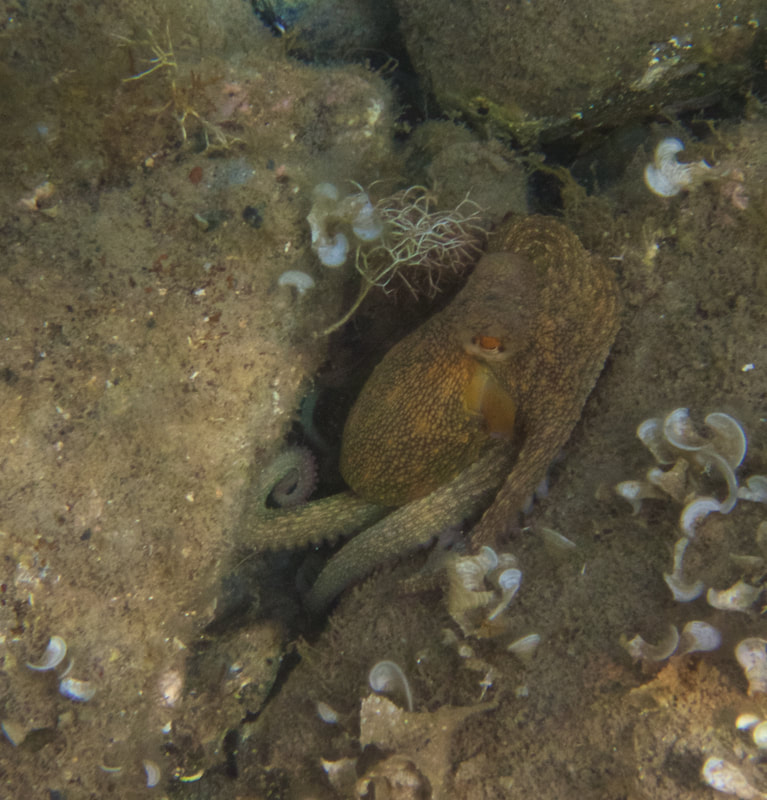
It was a small octopus, about, we think, some six inches across when its tentacles were curled into its body. It obligingly moved around a bit, and I called Martine to have a look at it; two of her photographs appear below. As it moved about, it changed colour, from a greenish-brown, fringed with palest green-to-white, to a darker speckled brown.
When we were on holiday in the Maldives, in February, we were lucky enough to observe – from a pier, looking into very clear, shallow water – a much larger octopus, which obligingly shifted around the seabed, for several minutes, in full view. Its motion could best be described as “flowing”, which it did for a few feet at a time, before pausing, almost “collecting itself”, the tentacles coming into the body, resting for a short while, then moving on. As it manoeuvred in this fashion, it changed colour too; this one went light blue round the edges as it halted. At times, our little local one was the colour of the seabed, which made following it more difficult.
Reading up about these strange creatures, we have learnt that they are considered very intelligent; there is a story that captive octopuses (the more correct plural, as the word is not Latin), have been known to leave their own tanks at night, climb into adjacent ones full of fish, eat the fish, and return to their own tank before morning. It is hard not to ascribe very human qualities to a creature capable of working out and performing this, but we should, I guess, be very careful before doing so: their brains and nervous systems are hugely different from ours. Wikipedia says that two thirds of their “neurons are to be found in the nerve cords of their arms, which show a variety of complex reflex actions which persist even when they have no input from the brain”.
Strange, too, is the fact that most octopuses only live for a period of up to five years; effectively, they breed once, and then die. This seems an extraordinary waste of all that brainpower and complex ability. We have seen a significantly larger octopus in the very same bay, so perhaps it offers ideal nursery conditions for the young.
Click on photos for larger image.
Our “Côte Rocheuse” has long stretches of high cliff, broken by deep bays, where many of the attractive coastal towns like Port Vendres and Collioure are situated. There are much smaller bays as well, some under the high expanses of rock, others within the larger inlets. Particularly if it is breezy, we spend a lot of time swimming around in these little, often idyllic places, and as they are fairly shallow, have come to notice the often subtle differences in the seabed.
Recently we were in exactly such a place; it is not at all deep, and provided with one or two large rocks, so few boats actually anchor there, and the seabed is relatively unscathed. Some of it is almost sandy, there are areas of small stones, and where the coastal rocks slide down into the sea, there are narrow cracks and small chasms, relatively deep and dark. Most of it is quite well “vegetated”, with large areas of low, gungy algae, and several of the white, whorled, flower-like things, which are called “peacock’s tail”. (I say “things” because I am not totally sure whether they count as plants or not!)
It was very sheltered and calm, and I was able simply to relax, enjoy my swimming, and have a good look at what was going on under the surface of the gently moving sea. There were quite a few little fish scooting around, often babies of the friendly saddled bream, which like to hang around under the hull of our boat. But, out of the corner of my eye, I saw a few, different fish, nosing between the stones; they were wrasse (I think of at least two kinds, certainly there were rainbow wrasse of both sexes), and they seemed to be concentrating on something, almost, one would say, harassing it. For a moment, I thought little of it, but then the “something” moved, and so I swam over to have a better look.
It was a small octopus, about, we think, some six inches across when its tentacles were curled into its body. It obligingly moved around a bit, and I called Martine to have a look at it; two of her photographs appear below. As it moved about, it changed colour, from a greenish-brown, fringed with palest green-to-white, to a darker speckled brown.
When we were on holiday in the Maldives, in February, we were lucky enough to observe – from a pier, looking into very clear, shallow water – a much larger octopus, which obligingly shifted around the seabed, for several minutes, in full view. Its motion could best be described as “flowing”, which it did for a few feet at a time, before pausing, almost “collecting itself”, the tentacles coming into the body, resting for a short while, then moving on. As it manoeuvred in this fashion, it changed colour too; this one went light blue round the edges as it halted. At times, our little local one was the colour of the seabed, which made following it more difficult.
Reading up about these strange creatures, we have learnt that they are considered very intelligent; there is a story that captive octopuses (the more correct plural, as the word is not Latin), have been known to leave their own tanks at night, climb into adjacent ones full of fish, eat the fish, and return to their own tank before morning. It is hard not to ascribe very human qualities to a creature capable of working out and performing this, but we should, I guess, be very careful before doing so: their brains and nervous systems are hugely different from ours. Wikipedia says that two thirds of their “neurons are to be found in the nerve cords of their arms, which show a variety of complex reflex actions which persist even when they have no input from the brain”.
Strange, too, is the fact that most octopuses only live for a period of up to five years; effectively, they breed once, and then die. This seems an extraordinary waste of all that brainpower and complex ability. We have seen a significantly larger octopus in the very same bay, so perhaps it offers ideal nursery conditions for the young.
Click on photos for larger image.